
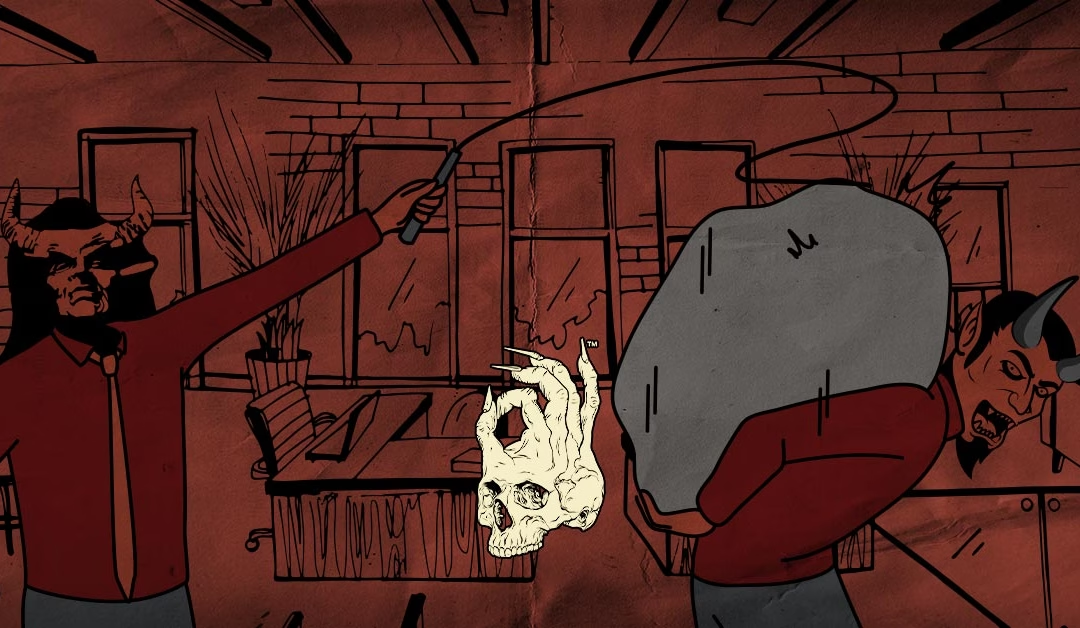
Workplace backstabbing is produced by environments where resources are scarce and advancement criteria are not transparent. Hellbeing on what is actually driving it and how to navigate it without being consumed by it.
Estimated reading time: 5 minutes
Workplace Backstabbing and What It Is Actually About
The colleague who takes credit for your work. The person who positions themselves as your ally in private and contradicts you in meetings. The one who shares information you gave them in confidence with someone who now has leverage over you. These things happen and they are worth naming clearly. They are also worth understanding correctly, because misunderstanding them — taking them personally in a way that treats the individual as the cause rather than the environment — leads to responses that do not solve the underlying problem.
What Creates the Conditions for It
Workplace betrayal is common in environments where resources are scarce and the criteria for getting them are not transparent. When promotions, recognition, and compensation are distributed through processes that are invisible or arbitrary, every colleague becomes a potential competitor in a game with unclear rules. The rational response to that environment is to protect yourself. Self-protection in that context often looks like undermining others — not because the people doing it are bad people, most of them are not, but because the incentive structure has made self-protection and advancement feel like the same goal.
The poor leadership environments where backstabbing is most common are precisely the environments where leaders have either created or failed to prevent the conditions that produce it. Vague advancement criteria, favoritism, decisions made in private and announced in public — these are the structural features that make colleagues into competitors and competition into something that looks a lot like betrayal.
Why It Feels Personal
Because it is personal. Someone who knew you, who you had a working relationship with, chose to prioritize their own advancement over the trust you had built. That is a real thing that happened and the hurt of it is legitimate. The clarification worth making is between the person and the system. The person made the choice. The system made the choice feel rational or even necessary. Understanding this does not excuse the individual behavior. It does prevent you from spending energy on a conclusion — “that person is uniquely terrible” — that, even if true, does not address the environment you are still living in.
What to Do With It
Document what happened when it happens. Not for revenge — for your own clarity and for protection if the situation escalates. The record exists independent of anyone’s memory or account of events.
Revise your information-sharing accordingly. You do not have to become suspicious of everyone. You have to be more deliberate about what you share and with whom. The people who have demonstrated over time that they handle information carefully are the ones who get the information that matters. The people who have demonstrated the opposite get less. This is not cynicism. It is pattern recognition applied to a working relationship.
The undervalued at work feeling and the backstabbed feeling often arrive in the same environment. Both are symptoms of a place where the conditions for good work — clear expectations, transparent recognition, trust — are not present. The individual incidents are the visible surface. The structural conditions underneath them are the actual problem. Knowing this does not make the individual incidents less real. It does make the decision about whether to stay in the environment more clear.
More at Infernal Insights.
How To
How to navigate workplace backstabbing without being consumed by it
- Document what happened when it happens
Not for revenge — for your own clarity and for protection if the situation escalates. Write down specifically what occurred, when, and who was involved. The record exists independent of anyone’s memory or later account of events.
- Revise your information-sharing based on demonstrated behavior
You do not have to become suspicious of everyone. You have to be more deliberate about what you share and with whom. Trust extended based on evidence is more durable than trust extended generously and violated. Adjust incrementally based on what people have actually shown you.
- Separate the person from the environment
Some people who behave badly in competitive environments are genuinely fine outside of them. Some are not. Do not write people off entirely based on workplace behavior alone. Also do not pretend that workplace behavior is not a real data point about who someone is. Both things can be true simultaneously.
- Assess whether the environment itself is the problem
Individual backstabbing incidents are the visible surface. The structural conditions that make backstabbing rational are the actual problem. If the incidents are frequent or escalating, the question worth asking is whether the environment is compatible with the way you want to work — not just whether you can manage the specific people involved.
Frequently Asked Questions
Document what happened when it happens. Revise what you share and with whom based on demonstrated behavior rather than assumed trust. Do not escalate unless the situation directly affects your work or standing, in which case escalate with documentation rather than emotion. And resist the urge to retaliate — it pulls you into the same dynamic you are trying to stay above.
Most workplace backstabbing is produced by environments where advancement criteria are unclear, resources are scarce, and the culture rewards visibility over substance. In those conditions, undercutting a colleague can feel rational — it removes a competitor and elevates the backstabber in the same move. It says more about the environment than it does about the individuals involved, though both are real.
Slowly and selectively. Trust after betrayal should be extended in proportion to demonstrated behavior over time, not restored immediately because someone apologized or the situation changed. Identify the specific behavior that was the problem and watch for whether it changes. Trust that has been rebuilt on evidence is more durable than trust that was extended generously and violated again.