
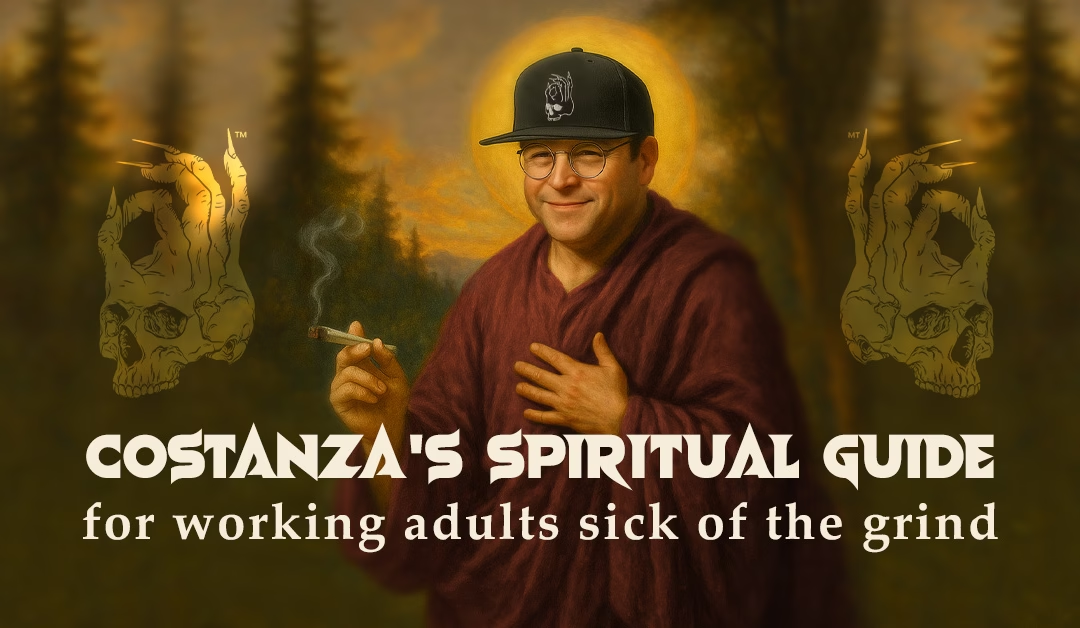
George Costanza has been misread as a cautionary tale. Hellbeing makes the case that he was actually operating from a coherent philosophy that hustle culture has been too loud to hear.
Estimated reading time: 9 minutes
George Costanza Is My Spirit Animal and I Stand By That
The morning routine content will tell you to wake up at five, meditate, journal three things you are grateful for, exercise, and consume something green before your first meeting. George Costanza woke up, lied about being an architect, and somehow kept his job at the Yankees for multiple seasons. Both of these are strategies for navigating adult life. Only one of them has been made into a thousand podcast episodes. The other one actually worked.
The Vandelay Industries Situation
George created an entirely fictional company, named it Vandelay Industries, listed it as a current employer, and used it as a reference for actual jobs. The company did not exist. The work history did not exist. The expertise in latex did not exist. And yet. He got jobs. He kept jobs. He navigated situations that would have ended the career of someone following the correct professional development path.
The lesson here is not that you should fabricate your credentials. The lesson is that confidence in the presentation of a thing is frequently more relevant than the thing itself — which is something every LinkedIn influencer has understood and deployed in the opposite direction. George understood it and deployed it to survive. That is a meaningful distinction.
The Desk Nap
George built a sleep compartment under his desk at the New York Yankees. He measured the space, acquired a shelf, and created a functional nap infrastructure inside his workplace. His reasoning, delivered with complete sincerity, was that sleeping at work was more efficient than commuting home to sleep and returning. This is not an insane argument. It is an extremely efficient argument that most people would not make because making it requires being completely unbothered by what it implies about your relationship to your employer.
George was not bothered. George had no relationship to maintain with his employer beyond the one that kept him employed. He was not performing dedication or signalling ambition. He was optimising his rest. In a different framing this is exactly what every productivity influencer says they are doing when they talk about sleep hygiene and performance. George just did it without the podcast.
The Return After Quitting
The corporate system runs on a very specific social contract. You behave as if the job matters in ways that extend beyond your own financial interest. You perform investment. You perform loyalty. George quit in a genuine emotional response to a genuine grievance, then showed up Monday morning and sat at his desk because he needed the income and decided the quitting was no longer operative. He simply declined to let the previous conversation determine the current situation.
Most people cannot do this. The shame infrastructure is too robust. The performance of consistency prevents them from just sitting back down at the desk on Monday. George had no shame infrastructure. This is usually described as a flaw. It might be the most useful thing about him.
The Peas
He ended a relationship because a woman ate her peas one at a time. Individually. One pea, then another pea, then another pea. He watched this happen and made a decision. The decision was final. He had a standard. The standard was not met. He acted accordingly.
People stay in relationships for years that are not working because ending them requires a reason that sounds reasonable when explained out loud. George ended a relationship for a reason that sounds unreasonable and moved on immediately. The pea thing is always cited as evidence of his dysfunction. It might be evidence of the opposite. He knew what he wanted. He recognised its absence. He left. That is actually a functional process. It just involved peas.
What Costanza Understood That Hustle Culture Does Not
Hustle culture is a performance of effort. The goal is to be seen working hard, to signal that you are the kind of person who sacrifices comfort for achievement. George had no interest in any of this. George expended exactly the energy required to maintain his situation and redirected everything else toward his own interests, comfort, and survival. He hustled when it served him. He did not hustle to signal that he was the kind of person who hustles.
This is a meaningful distinction that gets lost in the sea of five AM alarm content and cold plunge endorsements. The goal is not to work as hard as possible. The goal is to achieve what you actually want to achieve and not spend the remaining energy on performing the appearance of achieving more. George was extremely clear on what he wanted. He organised his entire life around those goals. He succeeded at them more consistently than most people succeed at theirs.
More of this at Infernal Insights. The apparel is for people who understood this before they found the words for it.
Frequently Asked Questions
That effort and performance of effort are not the same thing, and that the corporate system rewards the performance more than the substance. George understood this intuitively and navigated it accordingly. He expended exactly the energy required to maintain his situation and redirected everything else toward his own comfort and survival.
It depends on what you are trying to produce. If the goal is output measured by someone else’s metrics, hustle culture has an argument. If the goal is a life you actually chose, the anti-hustle position — doing what needs to be done without performing the appearance of doing more — is considerably more efficient.
Walk with purpose, look annoyed, and carry a folder. Beyond that — be specific about what you actually want, expend the energy required to get it and not significantly more, and do not let shame prevent you from course-correcting when a situation changes. It is not a formal system. It is just clear priorities without the performance layer on top.