
Myrcene: The Terpene Blamed for Couch-Lock
If you have spent any time around weed talk, you have heard about myrcene. It is the terpene people blame when a flower glues them to the couch, and it is the star of the old “eat a mango before you smoke” trick. It is also the terpene with the widest gap between how confidently people talk about it and how little is actually pinned down. So let me give you the version that does not oversell it: what myrcene is, what people credit it with, and the point where the story gets ahead of the science.
What myrcene is
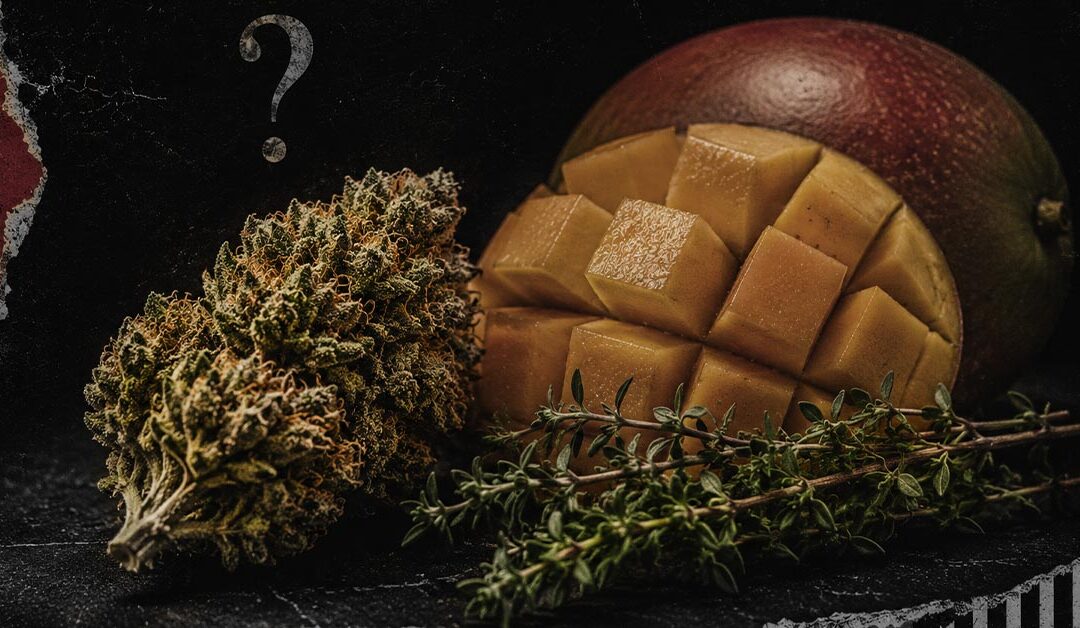
Myrcene is one of the most common and abundant terpenes in cannabis. Terpenes are the aromatic compounds that give the plant its smell, and myrcene is responsible for that earthy, musky, slightly herbal note with a little fruit underneath. It is the smell most people picture when they picture weed. It is not unique to cannabis either. The same compound shows up in mangoes, hops, lemongrass, and thyme, which is part of why those things share that earthy character.
The reputation: couch-lock
Myrcene’s whole reputation is sedation. It is the terpene most people blame for the heavy, drowsy, sink-into-the-cushions feeling, and it gets used as a rough dividing line for which flowers will feel heavy versus bright. That reputation is not pulled out of nowhere. Flowers high in myrcene do tend to be the ones people call relaxing, so there is a real pattern people are picking up on.
Where the science stands
Now for the part the confident charts skip. Most of the evidence that myrcene sedates you comes from animal studies, often at doses far higher than anything you would get from a joint. There is not strong human research showing that smoking a myrcene-heavy flower reliably makes you sleepy because of the myrcene specifically. It is a reasonable, plausible association. It is not a measured fact. The pattern people notice is real. The confident mechanism somebody prints underneath it is mostly guesswork. When you see a tidy chart explaining exactly what myrcene “does” to your body, what you are looking at is a hypothesis in a lab coat.
The mango thing
Then there is the mango. The claim is that eating a mango before you smoke will boost or stretch your high, because the myrcene in the mango helps THC cross into your brain more easily. It is a fun idea, and there is a sliver of real theory behind it. But there is no solid human evidence that eating a mango meaningfully changes your high. It is folklore wearing safety goggles. Eat the mango because mangoes are good. Do not expect a documented upgrade to your session.
What is safe to believe
So where does that leave you? A few things hold up. Myrcene contributes a lot to how cannabis smells and tastes. It tends to show up in flowers people find relaxing, so a deep, musky, earthy smell is a fair hint that a flower might lean heavy. And the human science on terpene effects in general is way behind what the marketing implies. Trust your nose to read a flower’s character. Do not trust a terpene chart to promise you a specific feeling, because the people printing those charts do not have that data yet.
It is the same lesson that keeps coming up with cannabis. Real information about smell and flavor keeps getting dressed up as precise pharmacology, because precise pharmacology sells better. The smell is good data. The certainty around it usually is not. For the same story aimed at the big number on your jar, there is High THC Doesn’t Mean Good Weed.
Frequently Asked Questions
Does myrcene cause couch-lock?
It is strongly linked to the heavy, relaxed feeling, and high-myrcene flowers do tend to be the sedating ones. But the human evidence that myrcene itself causes it is thin, so treat it as a hint, not a guarantee.
Does eating a mango before smoking get you higher?
Probably not in any way you would notice. The idea has a little theory behind it, but there is no solid human evidence that a mango meaningfully changes your high. It is mostly folklore.
What does myrcene smell like?
Earthy and musky, with an herbal edge and a touch of fruit. It is the smell a lot of people think of as classic weed, and it also turns up in mangoes, hops, and thyme.
Is high-myrcene weed always an indica?
No. The idea that a set myrcene percentage divides indica from sativa is an oversimplification with no real backing. Myrcene is a clue to character, not a category.
Is myrcene the most common cannabis terpene?
It is among the most common and abundant terpenes across a lot of cultivars, which is part of why its smell reads as so typically cannabis.
Want to experience myrcene in action? Hellbeing’s Platinum Kush pre-roll is a Catskills-grown indica-heavy hybrid known for its earthy, musky profile—a natural fit for those who appreciate the terpene’s character. Find it at licensed New York dispensaries.